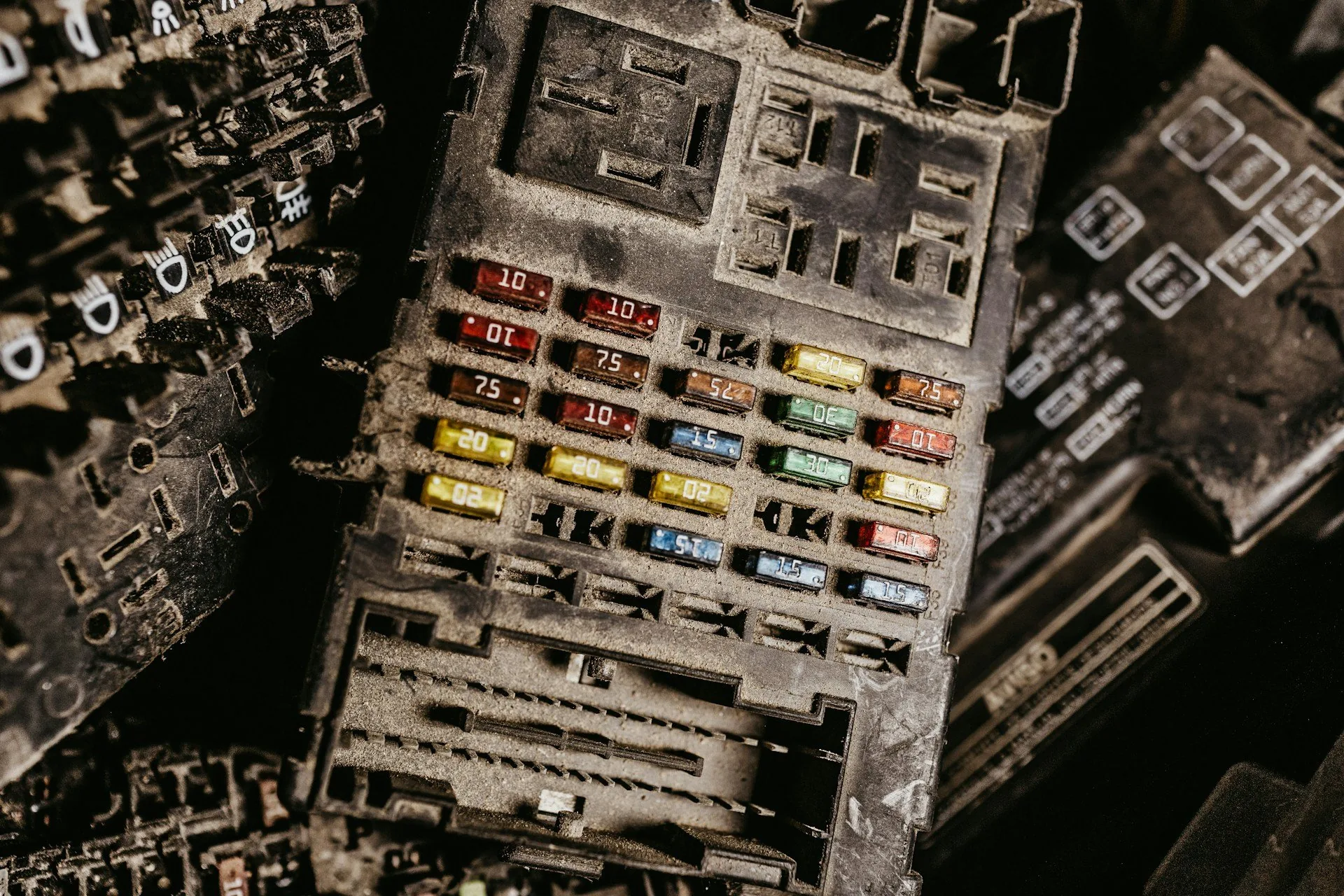


eFuse safety starts from a simple change: the protection that used to be a strip of metal is now a circuit running a model. In a low-voltage power net, an eFuse guards a wire by estimating its temperature from current. That is accurate and fast, and it means a healthy load can lose its supply because of a calculation.
What does an eFuse do in a low-voltage power net?
An eFuse switches a branch of the low-voltage power net and removes it when the current says the wire is in danger. A hard short trips a fast comparator within microseconds. Slower overloads go to a thermal model that integrates the square of the current with a leak, in the same form as the wire's own heating. The model opens the switch when the estimated temperature reaches a limit.
That behaviour has real advantages. The threshold can sit close to the wire's limit, so thinner and lighter wire becomes possible, and the channel can report what happened and be reset without a workshop visit. The price is that the margin a blade fuse carried by accident has gone. A melting fuse has a wide tolerance band and tends to leave generous room above normal load, while an eFuse is deliberately tuned close to the edge.
Why can an eFuse open a healthy steering feed?
An eFuse can open a healthy feed because the thermal model has a memory of recent current. Each pulse adds heat to the estimate, and the leak removes it only slowly. Loads with a low average current and high peaks are the difficult case, and electric power steering is exactly that sort of load. It draws very little during straight driving and a great deal during slow manoeuvres, when the driver depends on it most.
A fictional delivery van shows how this plays out. Its electric power steering (EPS) sits on a 12 V eFuse channel with a model tuned to reach 105 °C at 60 A continuous, from 45 °C ambient, with a 60 s time constant. Those are illustrative settings, and on paper the 60 A rating looks comfortable beside a peak draw of 80 A lasting a few seconds.
In a tight yard, the driver shunts back and forth. Each lock-to-lock move takes 80 A for 8 s, followed by 4 s at 3 A while the van changes direction. The mean of the current squared is 4,270 A², an effective 65 A, so the steady-state rise would be 71 K. Integrated over time, the estimate reaches 105 °C after about 102 s. The eFuse opens, correctly according to its model, and the van loses assist in the middle of a manoeuvre with no short and no damaged part.
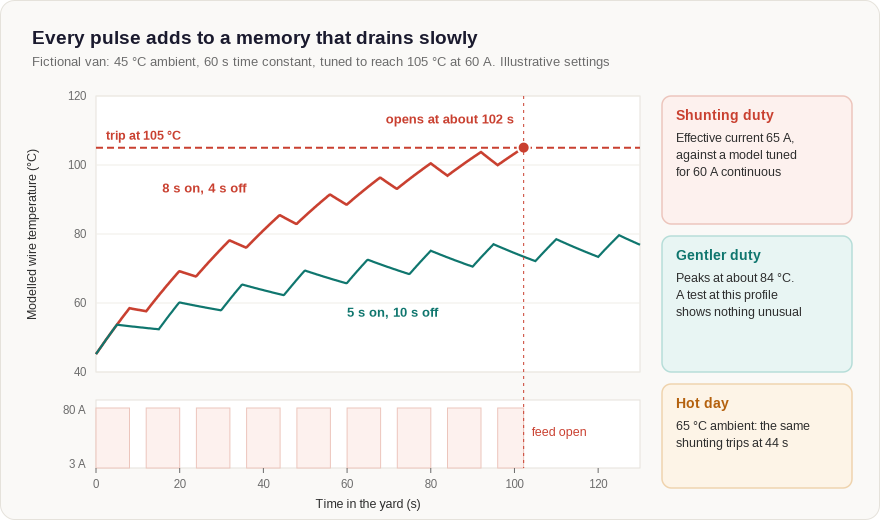
A gentler cycle of 5 s on and 10 s off settles with peaks at about 84 °C and never trips, so this behaviour is easy to miss in a test. A hot day moves the limit closer: with 65 °C ambient the same duty trips in about 44 s. Any Automotive Safety Integrity Level (ASIL) for this loss of assist depends on the project's vehicle, its mass and the situations studied, and the mechanical steering link remains as a fallback at higher effort.
How can the same model also leave a wire unprotected?
The same model can leave a wire unprotected because it only knows what it is told about the surroundings. A first-order model takes an ambient temperature as an input, for example from a sensor on the controller board or from a fixed assumption. The wire may run somewhere quite different.
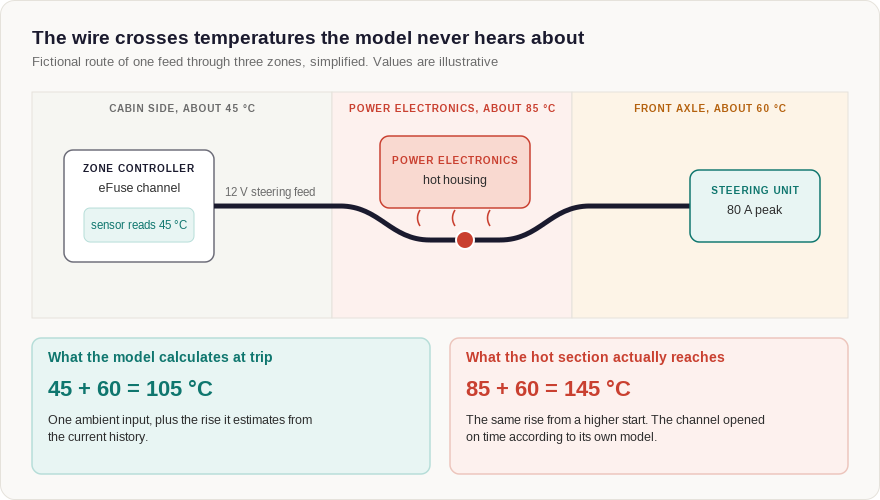
Suppose this feed passes close to a hot power electronics housing, so one section of the wire sits at 85 °C while the model assumes 45 °C. At the moment of trip the model believes the wire has reached 105 °C. That section has actually risen by the same 60 K from a higher start, reaching about 145 °C. A single ambient value has turned a safety mechanism into an optimistic estimate.
The two cases together show the real point. An eFuse can fail in either direction without any component breaking, through parameters and assumptions alone. It also holds two roles at once: it is a series element in the supply of a safety function, and it is the safety mechanism protecting the wire.
What should a safety concept say about an eFuse?
A safety concept should treat an eFuse's thermal parameters as safety-relevant data with an owner, and not as a harness engineer's private calibration. The load profile, including the worst repeating manoeuvre, belongs in the same conversation as the wire. So does the question of what the consumer does in the moment supply disappears.
For wider background, power and clock supervision covers how an electronic control unit behaves when its supply misbehaves, dependent failure analysis covers shared supply as a common cause, and the post on freedom from interference looks at how a less critical neighbour can disturb a safety function.
The full Low-Voltage Power Net and eFuse Safety concept goes where this post stops: voltage drop budgets, short circuit physics, fuse coordination, cranking and hold-up, redundant supplies, energy management, voltage bands and a worked supply architecture, with labs you can run.
Common questions about eFuse safety
Is an eFuse safer than a blade fuse?
Neither is automatically safer. An eFuse reacts faster and can report its state, while a blade fuse has essentially one failure mode. An eFuse adds active failure modes, including failing shorted, and parameters that can be wrong.
Can an eFuse fail short?
Yes. The power switch inside can fail shorted, and that fault may remain latent until a switch-off is attempted. Designs often keep a backup upstream and test the switching path where the load allows it.
Abbreviations & Key Definitions
- ASIL: Automotive Safety Integrity Level, a risk class assigned per hazardous event.
- eFuse: An electronic switch that protects a branch by measuring current and opening on a fault.
- EPS: Electric power steering.
- Thermal model: A calculation in the eFuse that estimates wire temperature from the current history.
Read the full Low-Voltage Power Net and eFuse Safety concept
From HARA to safety mechanisms: every concept with clear, practical explanations and real-world examples.
Start freeFree account: the complete Functional Safety Concept guide, 3 work-product templates, 5 practice exams a month and the Markov and RBD simulators. No credit card.
Start learning ISO 26262 for free
A free account opens the complete Functional Safety Concept guide, 3 work-product templates, 5 random practice exams a month and the Markov and RBD simulators. No credit card.
Last updated: 27 November 2026

Comments
Loading comments