ISO 26262 AcademyTraining for automotive safety engineers
Learn ISO 26262
by doing the work.
ISO 26262 Academy is the online training platform for automotive functional safety: 78 concept guides, 9 engineering simulators, 4,799 exam questions and 230 work-product templates, built around ISO 26262:2018 by a practising functional safety manager.
Two minimal cut sets. Trace how a fault reaches the top event.
- 78concept guides with diagrams and worked examples, 6 with a full video course
- 4,799exam questions across Parts 2 to 11, each with a written explanation
- 9simulators: FTA, FMEA, FMEDA, Markov, STPA, DFA, HAZOP, GSN, cascading failures
- 230 + 26work-product templates and process descriptions
- 70+video lessons with subtitles, synchronised to the concept pages
Counts are what a subscriber can open today, verified against the platform on .Independent educational platform. Learning achievements are not accredited professional certification.
What you are actually buying
The real product, not a brochure.
These are screens from the platform as it runs today. Four ways of working, one account: analyse, prove, understand, document.
- 01 · simulators
Simulators that behave like the tools you use at work.
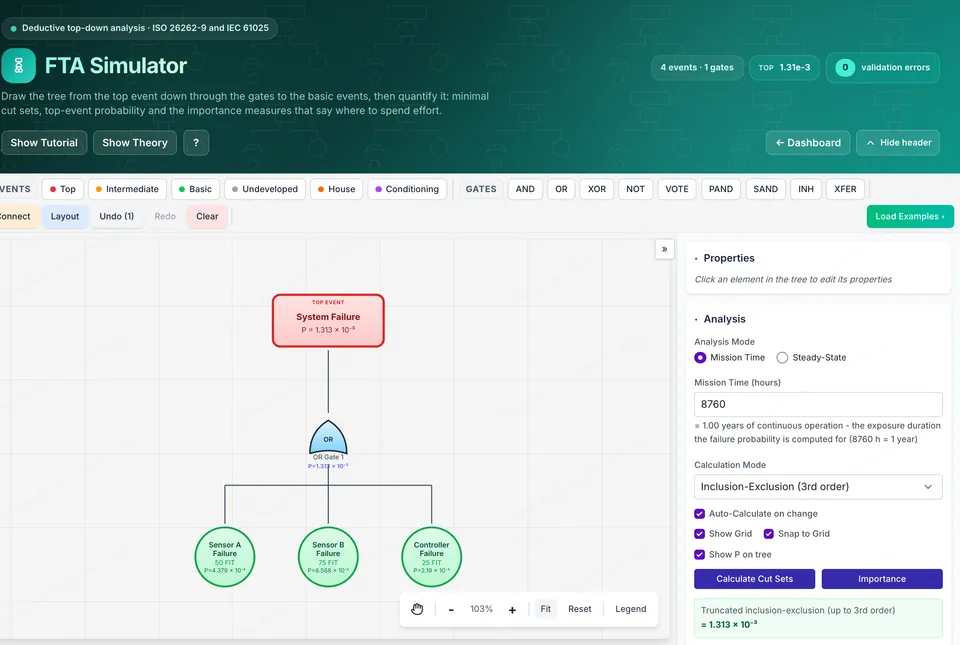
Build a fault tree and read its minimal cut sets. Apportion failure rates in an FMEDA and watch SPFM, LFM and PMHF move against the ASIL targets. Argue a safety case in GSN with live validation. 9 tools, each with worked automotive examples.
- FTA · FMEA · FMEDA · Markov
- STPA · DFA · HAZOP · GSN · Cascading
- JSON and CSV export
Markov is free for every registered user. FTA from Pro. All 9 on Expert.
Explore the simulators![The FTA Simulator with a three-event fault tree: a top event of 1.313 times ten to the minus three under an OR gate with Sensor A, Sensor B and Controller basic events rated 50, 75 and 25 FIT.]()
- 02 · exams
Practice exams that tell you why an answer is right.
4,799 questions across Parts 2 to 11 in five formats: multiple choice, fill in the blank, block diagram, drag and drop and AI-graded open text. Random, adaptive and thematic modes across 15 topic areas, with a written explanation on every question and a readiness report after three exams.
- 4,799 questions
- Random · Adaptive · Thematic
- Explanation on every answer
5 random exams a month on Free, 5 of each mode on Pro, unlimited on Expert.
See how the exams workThematic exam · HARA · Question 7 of 25ISO 26262-3Which of the following is not one of the parameters used to determine an ASIL in the hazard analysis and risk assessment?
- ASeverity of the harm
- BProbability of exposure to the operational situation
- CControllability by the driver or other persons
- DDetectability of the fault by a diagnosticCORRECT
- 03 · concepts
Concept guides that explain the reasoning, not just the clause.
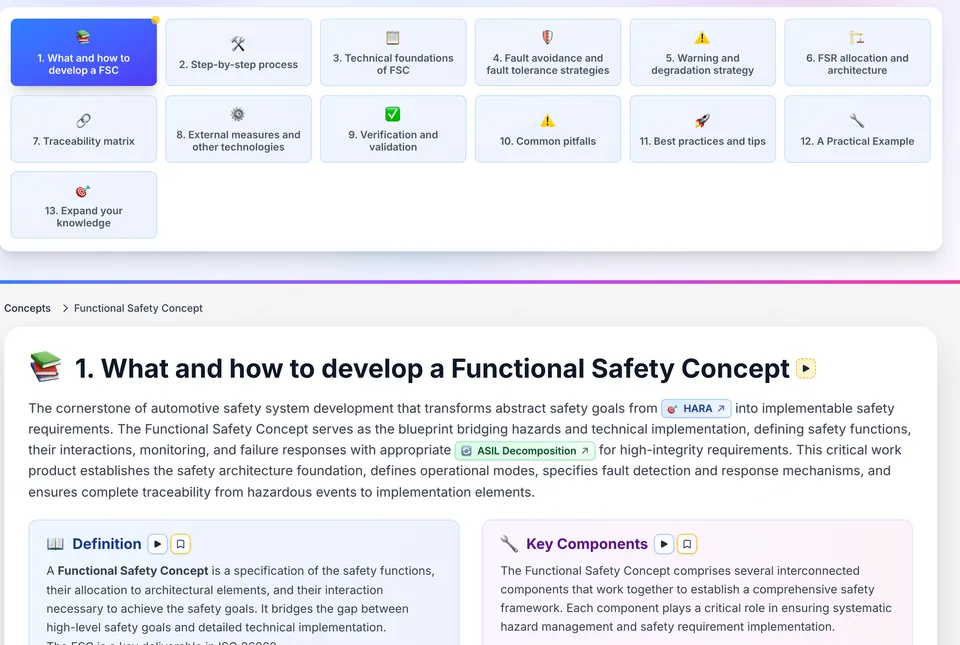
78 released guides organised along the safety lifecycle: HARA and ASIL determination, functional and technical safety concepts, hardware metrics, software qualification, SOTIF and the safety case. 6 of them carry a full video course - 70+ subtitled lessons across the platform, with diagrams that stay in sync as you watch - and the rest are written chapters with the same diagrams and worked examples.
- 78 guides
- 6 video courses
- Glossary and bookmarks
The Functional Safety Concept guide is free. 14 guides on Pro, all 78 on Expert.
See the full curriculum![The Functional Safety Concept guide: the thirteen-chapter grid from developing an FSC through traceability, verification and a practical example, and below it the first lesson with its definition and key components, HARA and ASIL decomposition links, and the synchronised video.]()
- 04 · templates
Work-product templates you can put straight into a project.
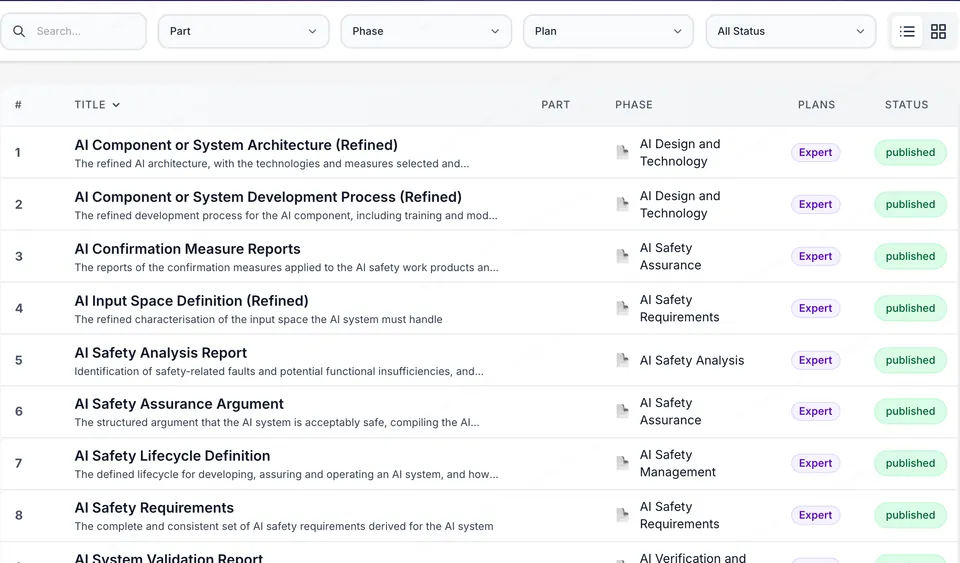
230 templates with chapter-by-chapter guidance and real examples, from the safety plan and HARA worksheet to the technical safety concept and verification report, plus 26 process descriptions and full Methods and Measures coverage.
- 230 templates
- 26 processes
- Downloadable from Pro
3 templates on Free, 75 on Pro, every template and process on Expert.
Browse templates and processes![The template library listing published work-product templates with their lifecycle phase and plan.]()
01 / A different way to learn
See it happen.
Feel it click.
Watch the explanation. Follow the diagram. Connect the dots. The free Functional Safety Concept guide keeps the video and the lesson in sync, so you can follow the reasoning as it unfolds.
Start the free FSC guide Full guide + videos. Free account. No credit card.First, notice the fault.
The clock starts when the fault occurs. Detection spends the first part of the time budget.
How fast is safe enough?
One fault. A limited time to handle it.
Follow each part of the response.
Detection takes time. Budget for it.Try a step. The explanation follows.
02 / A direction that fits you
Your background in.
Your next steps out.
A software engineer and a safety manager need different starting points. Career Path turns your role, experience and goals into a structured sequence of guides, practice and skill checks.
See how Career Path worksStart with you.
Change an answer. Watch the path adapt.
Your starting point shapes your next step.
Software safety / example roadmap
Functional Safety Concept
Start with the link between safety goals and requirements.
Software architecture & unit design
Build the reasoning behind a safe software design.
Freedom from interference
Understand memory, timing and communication isolation.
Check your software knowledge
Test your understanding and review the reasoning.
This is a sample sequence. The Career Path assessment refines your plan around your skills and gaps.
Looking for another role?Explore all 11 starting tracks
Start free. Upgrade when the project asks for more.
Pro for the individual learner. Expert for the complete toolkit, including all nine simulators and unlimited exams. Monthly billing shown; switch to yearly to save, or to the 3-year one-time option.
Free
Explore the learning style and start with the free functional safety concept.
- Released concept guides
- Work Product Templates
- Random exams per month
Compare billing and features
- 1Released concept guide
- 3Work Product Templates
- 1Process description
- Access to Markov Chain Simulator
- Safety case documentation builder
- Access to exam history and results
- 5Random exams per month
Pro
Build foundations with selected guides and focused exam practice.
- Released concept guides
- Work Product Templates · downloads included
- Random exams per month
Compare billing and features
- 14Released concept guides
- 75Work Product Templates
- Work products templates downloadable
- Access to FTA Simulator
- Access to Markov Chain Simulator
- Safety case documentation builder
- Access to exam history and results
- 5Thematic exams per month
- 5Random exams per month
- 5Adaptive exams per month
Expert
Work across the safety lifecycle with the complete learning library and tools.
- Released concept guides
- Access to FMEDA Simulator
- Unlimited Adaptive exams per month
Compare billing and features
- 84Released concept guides
- AllWork Product Templates
- AllProcess descriptions
- Work products templates downloadable
- Access to FTA Simulator
- Access to FMEDA Simulator
- Access to the FMEA Simulator
- Access to Markov Chain Simulator
- Safety case documentation builder
- Access to exam history and results
- UnlimitedThematic exams per month
- UnlimitedRandom exams per month
- UnlimitedAdaptive exams per month
- Access to STPA Simulator
- Access to DFA Simulator
- Access to Cascading Failures Simulator
- Access to HAZOP Simulator
- Access to GSN Safety Case Simulator
- 24hPriority Support
Prices shown are final. No VAT or other tax is added at checkout.
Secure payments powered by Stripe
For companies and teams
Train the whole safety team on one annual contract.
Every seat carries the full Expert plan. You add the people, assign guides and exams per role, and read competence evidence from one console. Per-seat rates fall as the team grows.
- Reassignable seats, five scoped roles, invitations by email or CSV.
- Exam assignment, deadlines and competence analytics per person and per team.
- Safety Case Tracker for the project’s work products and their status.
- LTI 1.3 and xAPI for your LMS, SSO and SCIM, one prorated annual invoice.
Questions engineers ask
Straight answers.
The questions visitors open most, answered the way the guides answer them. For anything about your own project, ask an expert.
What is ISO 26262?
ISO 26262 is the international standard for the functional safety of electrical and electronic systems in road vehicles. It defines a safety lifecycle, from management and concept through system, hardware and software development to production, operation and decommissioning, and it grades the rigour required by an Automotive Safety Integrity Level (ASIL). The current edition is ISO 26262:2018.
How many parts does ISO 26262 have, 10 or 12?
ISO 26262:2018 has 12 parts. The 2011 first edition had 10. The second edition added Part 11, guidelines for applying ISO 26262 to semiconductors, and Part 12, the adaptation for motorcycles. Parts 1 to 10 cover vocabulary, management, the concept phase, system, hardware and software development, production and operation, supporting processes, ASIL-oriented analyses and general guidelines.
How do I determine an ASIL?
An ASIL is determined in the hazard analysis and risk assessment (HARA) by rating each hazardous event on three parameters: severity (S0 to S3), probability of exposure (E0 to E4) and controllability (C0 to C3). The combination maps to QM (no ASIL) or ASIL A, B, C or D, with D the most demanding. The rating is made per hazardous event in its operational situation, never for a component on its own.
What is the difference between FMEA and FTA?
FMEA is inductive and bottom-up: it starts from individual failure modes and traces their effects up to the system. FTA is deductive and top-down: it starts from an undesired top event and decomposes its causes through logic gates down to basic events, which yields minimal cut sets and a top-event probability. ISO 26262 uses both, and the platform has an interactive simulator for each.
Who is ISO 26262 Academy for?
Automotive safety engineers, functional safety managers, ADAS and automated-driving engineers, hardware and software engineers moving into safety-related work, assessors, and students preparing for a functional safety career. Companies use the Teams plan to train whole departments on one contract.
What does the free plan include?
The free plan includes the complete Functional Safety Concept guide with its videos, three work-product templates, one process description, the Markov Chain Simulator, five random practice exams a month and your exam history. No credit card is required, and it does not expire.
How many exam questions does the platform have?
4,799 questions a subscriber can actually be asked, covering Parts 2 to 11 of ISO 26262:2018 in five formats: multiple choice, fill in the blank, block diagram, drag and drop and AI-graded open text. Every question has a written explanation. Exams run in random, adaptive and thematic modes.
Which simulators are included?
9 simulators: FTA (fault trees, minimal cut sets, top-event probability), FMEA (worksheet with action priority), FMEDA (SPFM, LFM and PMHF against ASIL targets), Markov chains (continuous-time reliability models), STPA, DFA (dependent failure analysis), cascading failures and freedom from interference, HAZOP and a GSN safety case builder. Markov is free for every registered user; the full set is on the Expert plan.
What is the difference between ISO 26262 and IEC 61508?
IEC 61508 is the generic functional safety standard for electrical, electronic and programmable systems across industries. ISO 26262 is its automotive adaptation: it uses ASILs instead of SILs, adds the HARA with severity, exposure and controllability, defines the hardware architectural metrics SPFM, LFM and PMHF, and covers the full vehicle lifecycle from item definition to decommissioning.
Is ISO 26262 mandatory?
ISO 26262 is not a law, but it is the de facto requirement of the automotive supply chain. Most OEMs make compliance a condition of supply, and it is the recognised state of the art that regulators and courts refer to when a product-liability question arises, so in practice it is mandatory for anyone building safety-related vehicle electronics.
Can I ask questions to a real functional safety expert?
Yes. The Expert Consultation service connects you with human functional safety engineers, not an AI. You submit the question, receive a quote, and get a written answer with follow-up clarification. Typical topics are safety analyses, ASIL decomposition and safety mechanisms, gap assessments and audit preparation, hardware metrics and software partitioning.
What is a safety case in ISO 26262?
A safety case is the structured argument, supported by evidence, that an item is acceptably safe for its intended use. It compiles the work products of the safety lifecycle into claims, arguments and evidence, often in Goal Structuring Notation (GSN), and it is what the independent functional safety assessment reviews.
Start today
Become the engineer your team trusts when safety is on the line.
The free plan gives you the complete Functional Safety Concept guide, the Markov simulator and five practice exams a month. Upgrade when the project asks for more.