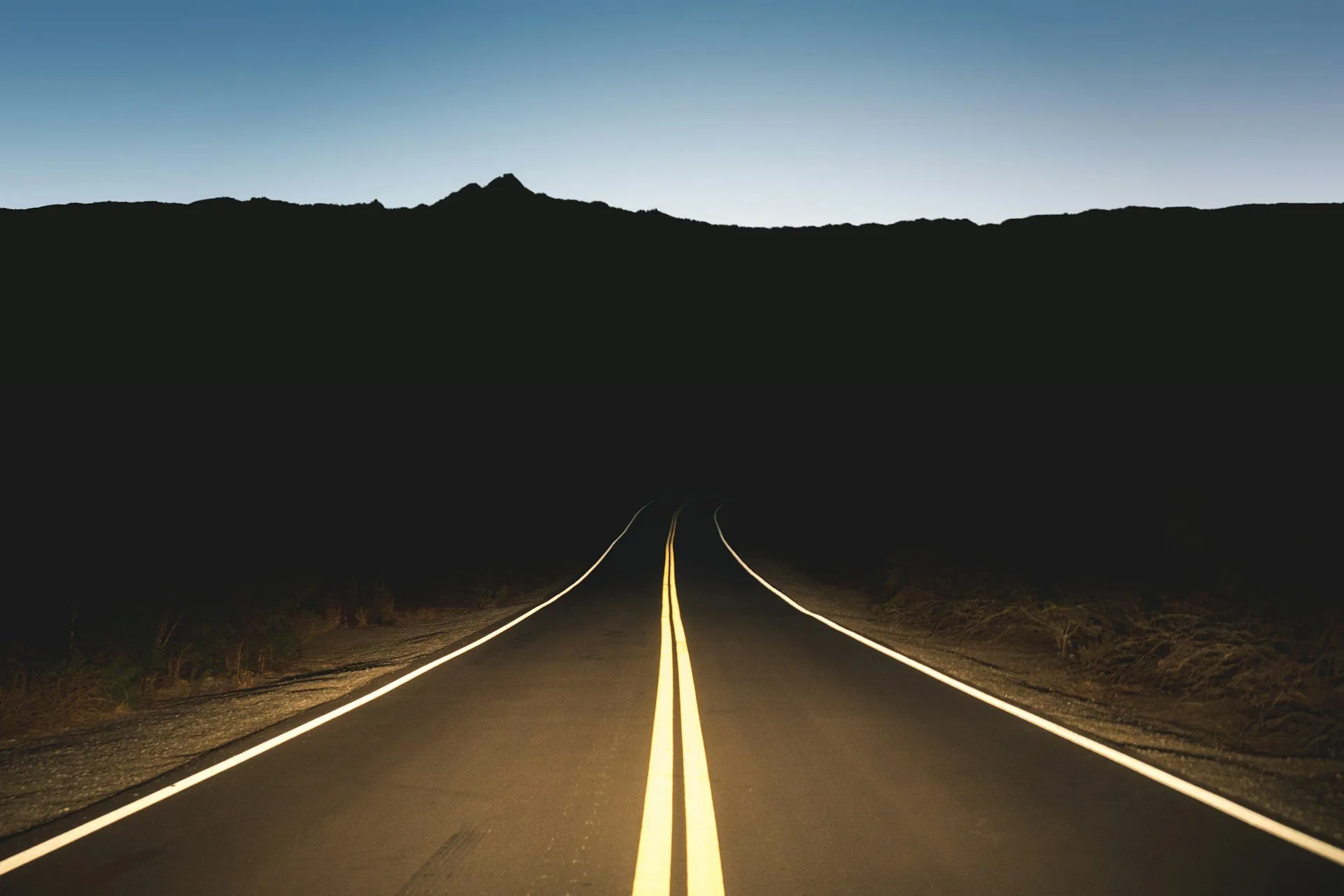


Headlamp safety is usually discussed as a question of failed lamps, yet modern exterior lighting can lose much of its output with no fault at all. An LED headlamp reduces its current when it gets hot, to protect the LEDs. That protection is correct behaviour, and it can take away more of the driver's margin at night than the percentage suggests.
What is headlamp safety really about?
Headlamp safety is about whether a driver can see an obstacle in time to act on it. A lamp is an electronic system these days, with a driver stage, a controller, thermal management and often a network connection. Each of those can reduce or remove light, and a sudden loss at speed in the dark is an obvious hazard.
Any Automotive Safety Integrity Level (ASIL) for losing low beam comes from a project's own hazard analysis, using its assumptions about exposure, severity and how a driver reacts. A driver notices sudden darkness at once. A gradual dimming gives no clear signal, so the driver may keep driving at the same speed with a shorter margin and no warning.
Why does an LED headlamp dim itself?
An LED headlamp dims itself because most of the electrical power becomes heat at the junction, and a hot junction emits less light and ages faster. In a closed lamp on a hot night, the air inside can be very warm. The driver stage measures temperature and cuts current as the junction approaches its limit.
No part has failed, and no fault code needs to appear. That is why thermal derating deserves its own place in a safety concept. It is a protective function that competes directly with the function the driver depends on.
How much seeing distance does half the light cost?
Half the light costs about 29 percent of the seeing distance, because illuminance falls with the square of distance. Light spreads over an area that grows with distance squared. If an object needs a fixed amount of light to be noticed, seeing distance scales with the square root of the lamp's intensity, and the square root of 0.5 is about 0.71.
A 29 percent loss sounds more comfortable than a 50 percent loss, and the sum does not stop there. What the driver actually needs is the seeing distance compared with the stopping distance.
Take a fictional pick-up on an unlit road on a hot night, travelling at 90 km/h, or 25 m/s. Assume a reaction time of 1 s and braking at 7 m/s². The driver travels 25 m before braking and 44.6 m while braking, which makes 69.6 m. Assume low beam at full output reveals a pedestrian in dark clothing at 70 m. All these values are illustrative, and intensity is treated as proportional to current. On those numbers the driver stops 0.4 m short.
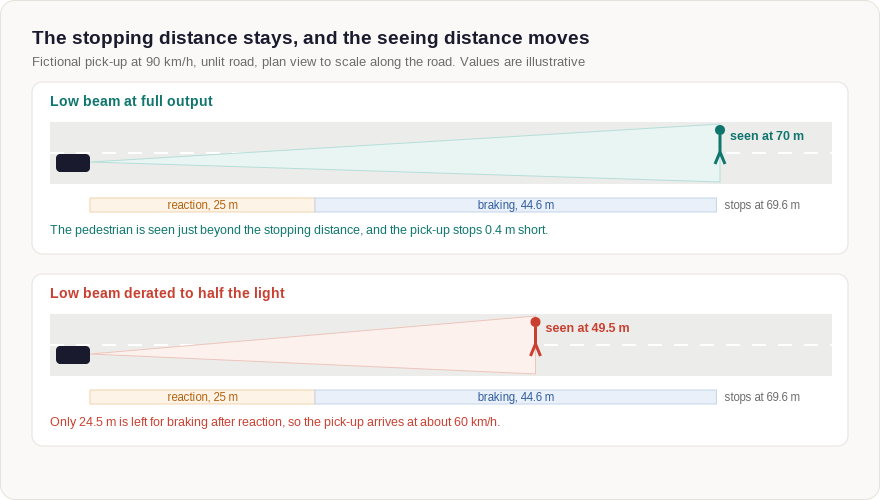
Now the lamp derates to 50 percent. The pedestrian appears at 70 × 0.71 = 49.5 m. After the 25 m of reaction, 24.5 m remains for braking, which brings the speed down from 25 m/s to only 16.8 m/s. The pick-up reaches the pedestrian at about 60 km/h. The original margin was almost nothing, so most of the lost distance turns straight into impact speed.
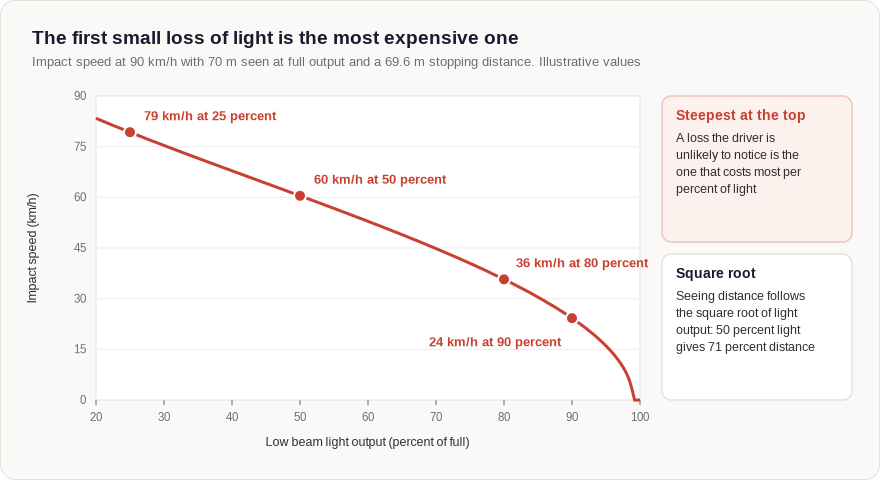
The shape of the curve is the important result. The first small loss of light causes the steepest rise, since the driver was already using the whole distance. A reduction to 90 percent output, which a driver is unlikely to notice, already gives an impact at about 24 km/h on these numbers.
What does thermal derating teach about lighting design?
Thermal derating teaches that a protective function needs its own safety argument. The team that owns the LED lifetime and the team that owns the safety goal both have a valid requirement, and they pull in opposite directions. How far the output may fall, for how long and what the driver is told are safety decisions that should not be left inside a driver stage calibration.
The same tension appears wherever hardware protection touches a safety function. Hardware engineering covers the thermal and electrical design side, safety mechanisms and diagnostics looks at what can be detected, and the post on display safety shows why telling the driver is not a simple add-on.
The full Exterior Lighting and Signaling Safety concept goes where this post stops: the lamp functions, hazard analysis, glare physics, matrix beam latency, LED driver diagnostics, common cause failures, limp-home paths, brake lamp timing and the safety goal worked through to verification.
Common questions about headlamp safety
Does ISO 26262 apply to headlamps?
Yes. A modern headlamp is an electrical and electronic system whose malfunction can create a hazard, so ISO 26262 applies to it. Separate regulations set the required photometric performance, and they work alongside the functional safety argument.
Is thermal derating a fault?
No. Thermal derating is designed behaviour that protects the LEDs from heat. It still matters to safety because it reduces light that the driver relies on, so the concept has to bound how far it can go.
Abbreviations & Key Definitions
- ASIL: Automotive Safety Integrity Level, a risk class assigned per hazardous event.
- Illuminance: The amount of light falling on a surface, measured in lux.
- LED: Light-emitting diode.
- Seeing distance: The distance at which a driver detects a given object.
- Thermal derating: Reducing current as temperature rises to protect a component.
Read the full Exterior Lighting and Signaling Safety concept
From HARA to safety mechanisms: every concept with clear, practical explanations and real-world examples.
Start freeFree account: the complete Functional Safety Concept guide, 3 work-product templates, 5 practice exams a month and the Markov and RBD simulators. No credit card.
Start learning ISO 26262 for free
A free account opens the complete Functional Safety Concept guide, 3 work-product templates, 5 random practice exams a month and the Markov and RBD simulators. No credit card.
Last updated: 25 November 2026
Comments
Loading comments