Tag

Articles tagged freedom-from-interference

5 articles

Close-up of a car's drilled brake disc and caliper on the hub, with sensor wiring running behind it.Technical

Freedom from Interference: When QM Code Shares an ECU with ASIL D

A QM tyre pressure function and ASIL D slip control on one brake controller, and a memory protection test that passes at every speed. Freedom from interference is three questions, not one. Memory, timing and communication interference each need a different kind of evidence, and a clean result for one says nothing about the other two. New article, with a brake controller hosting indirect tyre pressure monitoring as the worked example.

6 min
Engine bay of a modern car seen from the front, with wiring harnesses, connectors and control units routed around the engine.Technical

The Black Channel: Moving Network Safety to the Sender and Receiver

A CAN frame can pass every checksum on the bus and still carry the wrong request. One way to argue the integrity of a safety-related message rests it on the sender and the receiver, not on the network between them. This is the black channel idea, and the most common reason end-to-end protection exists. New article, with an electric parking brake release request replayed by a gateway as the example.

6 min
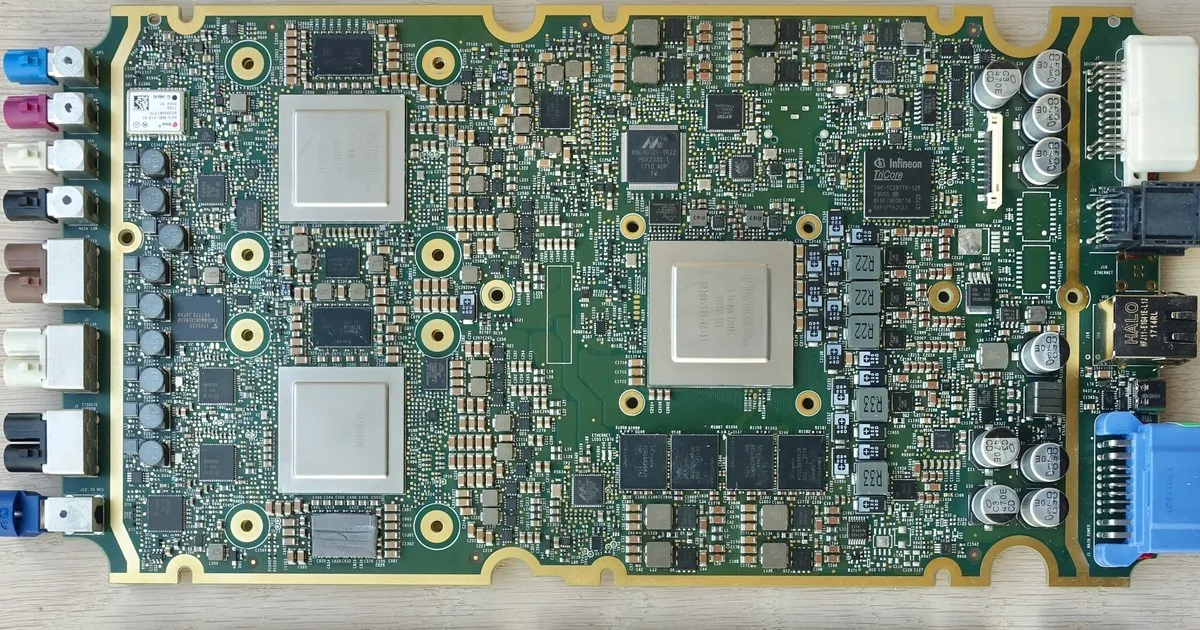
An automotive driver-assistance controller board with two identical processor packages side by side, next to a larger processor, memory, power components and a row of connectors, all on one PCB.Technical

The Core Concept of Dependent Failure Analysis in ISO 26262

Two redundant channels are not automatically independent. What a dependent failure is, the difference between common cause and cascading failures, the coupling factors that tie elements together, and why ISO 26262 asks for DFA.

7 min
An engineer at a desk writing an AUTOSAR-style CAN driver in C for an ECU, with a cross-compiler build finishing with zero errors and a laptop showing ECU software domains and CAN traffic.Technical

Software in ISO 26262: A Fault With No Failure Rate

Software has no failure rate, so ISO 26262 cannot count it. What the standard asks for instead, why software is both the safety net for hardware faults and a source of its own, and why Part 6 converges on the software architecture.

7 min
Close-up of a densely populated circuit board, with a square multi-pin integrated circuit in sharp focus among capacitors and smaller packages.Technical

Multi-Core Safety Architectures: An ISO 26262 Overview

Multi-core automotive SoCs add shared hardware, mixed criticality, and timing interference to every safety argument. This article maps the families of multi-core safety architecture, the three interference concerns underneath them, and what actually decides which one fits.

6 min

Related ISO 26262 guides

Each guide is a full course with diagrams and worked examples. Open one to see what it covers.

Browse all guides
  • System levelFreedom from Interference (FFI)Learn how to ensure elements of different ASILs do not interfere through temporal, spatial, and data partitioning. Covers MPUs, hypervisors, bus monitoring, multi-core strategies, and evidence generation for assessments.Expert plan pricing10 chapters
  • System levelIn-Vehicle Network SafetyWhat CAN, CAN FD, CAN XL, LIN, FlexRay and automotive Ethernet actually guarantee, the communication failure catalog of ISO 26262-6 Annex D, receiver-driven signal contracts, the black-channel argument, AUTOSAR E2E protection, containment, gateways and the comm matrix as a safety artifact.Expert plan pricing14 chapters
  • Safety analysesDependent Failure Analysis (DFA)Learn how ISO 26262-9 Clause 7 verifies that redundant channels and ASIL decomposition are genuinely independent, by hunting dependent failure initiators and coupling factors that let one root cause defeat several safety elements at once.Expert plan pricing11 chapters
freedom-from-interference Articles | ISO 26262 Academy Blog