


An electronic control unit (ECU) runs code and reads data. The code passes through reviews and tests. The data, often thousands of values, is tuned by other people with other tools, much of it after the code is frozen. A monitor that is coded perfectly still fails if its threshold sits in the wrong place. This article explains the two kinds of data ISO 26262 distinguishes, how each one gets its ASIL, and how to specify, verify and protect them.
The build is the dividing line
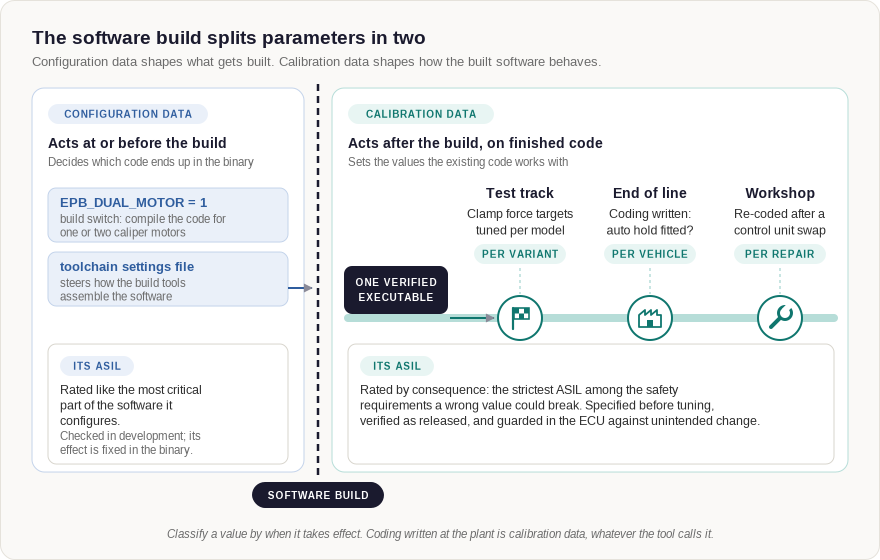
ISO 26262 sorts parameter data by one question: does the value take effect before or after the software build?
Configuration data acts at or before the build and decides which code ends up in the executable. A build switch that compiles the code for a single or a dual motor electric parking brake (EPB) is configuration data, and so is a settings file that steers the build toolchain. Once the build is done, the effect of that choice is fixed in the executable.
Calibration data acts after the build. The code is finished, and calibration supplies the values its existing functions use, usually as a dataset stored next to the code: thresholds, characteristic curves, timing constants, values learned per vehicle. It is applied at several points, often long after code freeze: tuned on the test track for each vehicle model, coded at the end of the production line for each car, and rewritten in the workshop when a part is replaced.
Both kinds are pure data: a change that needs behaviour no existing code path implements is a software change. Classify a value by when it takes effect, not by what it is called. Variant coding sounds like configuration, but because it is applied to finished software it is calibration data.
Each value inherits its ASIL
Parameters get no hazard analysis of their own. They inherit an ASIL, and the two kinds of data follow different rules.
A configuration value is rated by reach. A wrong switch can select the wrong code for the whole configured software, so it is rated like the most critical part of it.
A calibration value is rated by consequence. Ask which software safety requirements a wrong value could break; the value carries the strictest ASIL among them. The question is not which controller the value lives in, but what it can break.
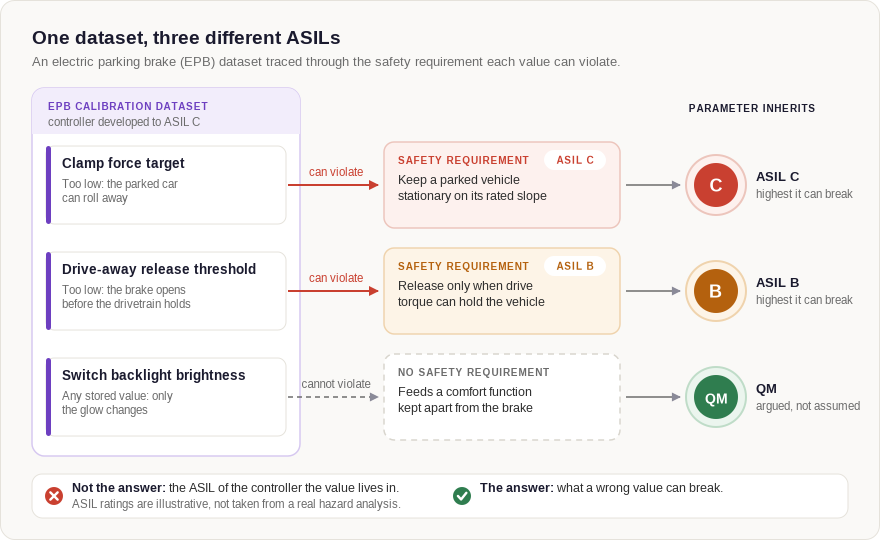
Take an EPB controller developed to ASIL C, with illustrative ratings. If the clamp force target is set too low, a parked car can roll away, so the parameter inherits the ASIL C of the hold requirement. A drive-away release threshold set too low lets the brake open before the drivetrain holds the vehicle on a slope, which in this example violates an ASIL B requirement. The brightness of the switch backlight can break neither, so it can stay QM.
A QM rating holds only if you can show that no stored value, including a corrupted one, can reach a safety function, for example because only a separate comfort function reads it and that function cannot interfere with the brake. Without that argument, rate the value by the requirements around it.
Specify before anyone tunes
A value without a specification cannot be verified. For each safety-related parameter, the specification states which values are valid, with range, scaling and units, what the parameter is for and how the software uses it, and how it depends on other values. Calibration data adds two things: valid ranges may change with the operating state, and dependencies can reach beyond one dataset, into the datasets of other ECUs or into the configuration that selected the code the values feed.
The specification is then verified: does it match the software safety requirements and the design, and is it consistent with the other parameters? Configurable software must be verified with the configuration actually used, though only the behaviour that depends on that configuration has to be covered again.
Calibration needs one more step. The dataset released for production must be checked against its specification, and the calibrated software must be shown to deliver its safety functions with exactly those values. Much of this happens at vehicle level. The way calibration data is produced is specified too: procedures, generating tools and checks. Those tools need the same confidence argument as any other tool in the safety lifecycle, because a tool that silently writes a wrong value is a fault source.
Guard the data in the vehicle
The effect of configuration data is settled at build time. Calibration data often stays rewritable, at the end of line and in the workshop, so unintended changes to safety-related calibration values must be detected in the ECU. ISO 26262 grades three detection mechanisms by ASIL:
- Plausibility checks confirm that a value lies inside its specified range and agrees with related values. Highly recommended at every ASIL.
- Redundant storage with comparison keeps a second copy and compares both before use. Recommended at ASIL A to C, highly recommended at ASIL D.
- Error-detecting codes, such as a cyclic redundancy check (CRC) over a data block, reveal corrupted bits. Same grading as redundant storage; the code may also be computed in hardware.
The mechanisms complement each other. A CRC detects nearly all accidental corruption of a block, with a small residual risk that depends on the code chosen. It says nothing about whether the values were right when written, or whether the dataset belongs to this vehicle variant. A range check catches absurd values but misses a corruption that still looks plausible. And detection alone protects nobody: every check needs a specified and tested reaction, such as falling back to verified substitute values or degrading the function to a safe state.
Three misreadings
- "The code is verified, so the product is verified." The code ships with one dataset out of many. The evidence has to cover the released values too.
- "The controller is ASIL D, so every parameter is ASIL D." Safe but expensive, and it hides the values that really matter. Derive each rating from what a wrong value can violate.
- "A checksum proves the data is right." At best it shows the data is unchanged. Whether it was right is settled by the specification and the release verification.
Going further
This article covers the rules. The Calibration & Parameter Safety concept turns them into practice: parameter specifications that hold up in an assessment, the road from live tuning to a released dataset, layered protection in the ECU, variant management, and locking calibration access in production vehicles.
Abbreviations
- ASIL - Automotive Safety Integrity Level, A (lowest) to D (highest).
- CRC - Cyclic Redundancy Check.
- ECU - Electronic Control Unit.
- EPB - Electric Parking Brake.
- QM - Quality Management: no ASIL is assigned and the normal quality process applies.
Read the full Calibration & Parameter Safety concept
The same binary, a thousand behaviors: configuration data vs calibration data, ISO 26262-6 Annex C requirements, A2L and XCP workflows, CRC and plausibility protection in the ECU, dataset release, variant coding risks and tool confidence.
Read the guideKeep learning with a free account
A free account opens the complete Functional Safety Concept guide, 3 work-product templates, 5 random practice exams a month and the Markov and RBD simulators. No credit card.
Last updated: 20 November 2026



Comments
Loading comments