

End to end driving safety is the problem of arguing that a single learned network, mapping sensors directly to driving actions, is safe when it has no internal modules to specify and test separately. The usual answer is a simple runtime checker beside the network. A checker is valuable and verifiable, but it can only reject what it can state in rules. The harder part of driving often sits in judgement that nobody wrote down.
Why is end-to-end driving hard to argue under ISO 26262?
End-to-end driving is hard to argue under ISO 26262 because the standard's methods assume behaviour that people wrote down and can trace. A classic modular stack has a perception module, a prediction module and a planner, and each has a specification, an interface and a test. An end-to-end network has inputs, millions of weights and an output. Its internal values have no individual meaning, so there is no object list to check halfway and no unit to review.
ISO 26262 still applies to much of what surrounds the network. The hardware that runs it, the inference code and the mechanisms around it are ordinary engineering, and the existing methods work well on them. Behavioural risk is a different matter, and that is where ISO 21448 and the guidance for machine learning, covered in the post on ISO/PAS 8800, take over. Since one set of weights carries every behaviour at once, independence cannot come from inside the network. It has to come from something beside it.
How does a doer and checker architecture help?
A doer and checker architecture helps by moving the safety argument from a component that is hard to verify onto one that is easy to verify. The network, the doer, proposes a trajectory. A small rule-based checker decides whether that proposal may be used, and if it may not, a fallback takes over. Most of the argument then sits with those two small parts, and conventional methods handle them well.
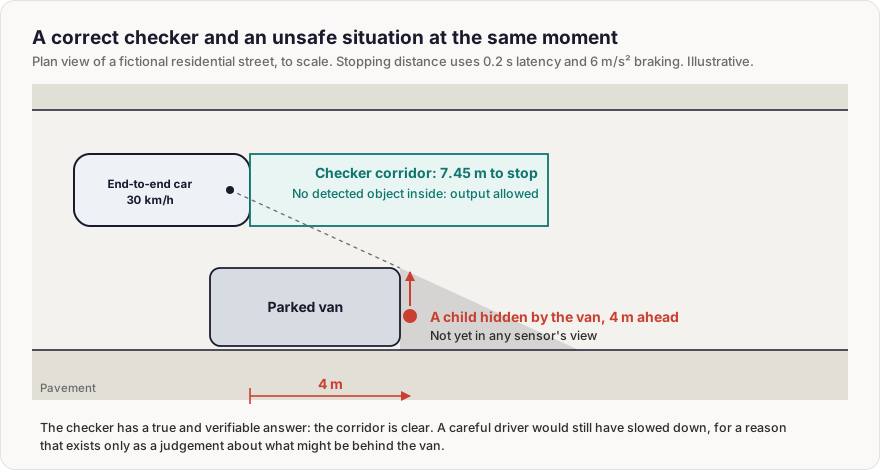
A fictional residential street shows what this buys and where it ends. The car is driving at 30 km/h past a parked van. Its checker computes the distance needed to stop, using 0.2 s of latency and 6 m/s² of braking, and arrives at 7.45 m. It confirms that no detected object lies in that corridor, then allows the proposed trajectory. The result is correct, verifiable and exactly what the specification asked for.
What can a runtime checker not check?
A runtime checker cannot check a danger that is absent from its inputs and absent from its rules. A child is standing behind the van, 4 m ahead of the car's front bumper, and is about to step out. Nothing in any sensor's view shows this. The corridor is clear, and the checker's verdict stays correct until the moment the child appears.
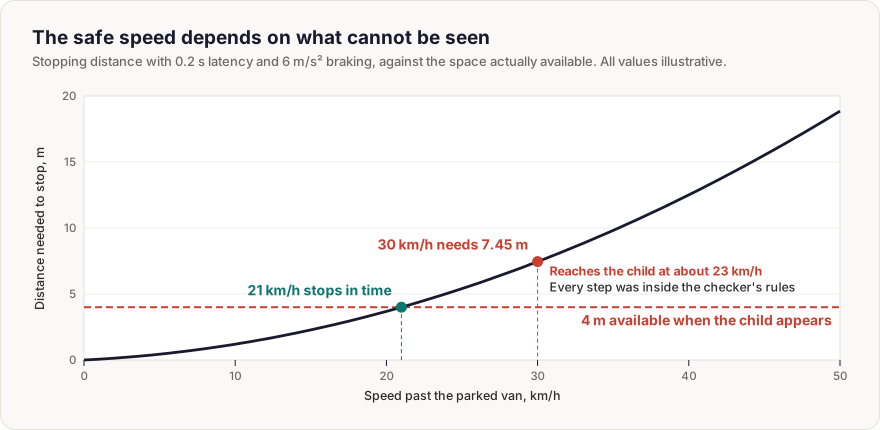
By then the distance is too short. With 4 m available, the car would need to be travelling at 21 km/h or less to stop in time. From 30 km/h it reaches the child at about 23 km/h, with the brakes fully applied and with every step inside the rules.
A careful human driver would have slowed down, and a well-trained network may slow down too, for reasons nobody can read from its weights. Yet the argument cannot rely on that, because the checker does not verify it. An engineer can add a rule that limits speed near large parked vehicles. That rule then has to be defined for vans but perhaps not for low trailers, and for residential streets but perhaps not for motorways. Each new rule adds false interventions as well, and rule by rule the simple checker grows towards the complicated driver it was meant to supervise.
The insight to carry away is that a checker's guarantee and the system's safety are separate quantities. Coverage of what the checker can express says nothing about the risk lying beyond it, and that remainder has to be argued some other way: scenario evidence, field monitoring and a clear statement of where the function may operate. The SOTIF view of functional insufficiencies gives that remainder a place in the argument, and platform separation keeps a failing network from taking its checker with it. Any ASIL here is specific to one project's hazard analysis, and it applies to the event, never to a technology as a whole.
The Foundation Models and End-to-End Driving Safety concept page adds how these models work for beginners, what ISO 26262 still covers, what the machine learning and SOTIF guidance offer, the design of checkers and their limits, uncertainty signals, hallucination-like failures, data coverage, scenario testing, shadow mode, explainability, and the safety case that can still be made.
Common questions about end-to-end driving safety
Can ISO 26262 be applied to an end-to-end neural network?
Partly. It applies well to the hardware, inference code and surrounding mechanisms. Its software methods fit learned behaviour poorly, so other guidance has to cover what the weights do.
Does a checker make the network safe?
It makes specific rejectable outputs safe, provided the fallback works. A checker says nothing about hazards that its rules and inputs cannot express, so a further argument is still needed.
Could more rules close the gap?
Only partly. Rules help for known situations, but each adds complexity and false interventions. At some point the checker stops being simple enough to verify easily.
Abbreviations & Key Definitions
- ASIL: Automotive Safety Integrity Level, assigned for a specific project.
- Doer and checker: An architecture in which a simple verified element supervises a complex one.
- End-to-end network: A learned model mapping sensor inputs directly to driving outputs.
- SOTIF: Safety of the intended functionality.
Last updated: 16 November 2026
Comments
Loading comments