 ISO 26262Academy
Integrating a mainline Linux kernel into an automotive compute platform introduces a fundamental clash between evolutionary open-source development and the rigid reference lifecycle of ISO 26262 Part 6. This article breaks down the engineering prerequisites for translating open-source transparency into valid functional safety evidence without relying on generic software reputation.
The Transparency Paradox
Functional safety standards categorize software developed outside of your specific project lifecycle as pre-existing software. This category includes commercial off-the-shelf (COTS) products and open-source software. Open source offers unprecedented transparency through public repositories, commit histories, and issue trackers. However, this transparency does not automatically equate to safety evidence.
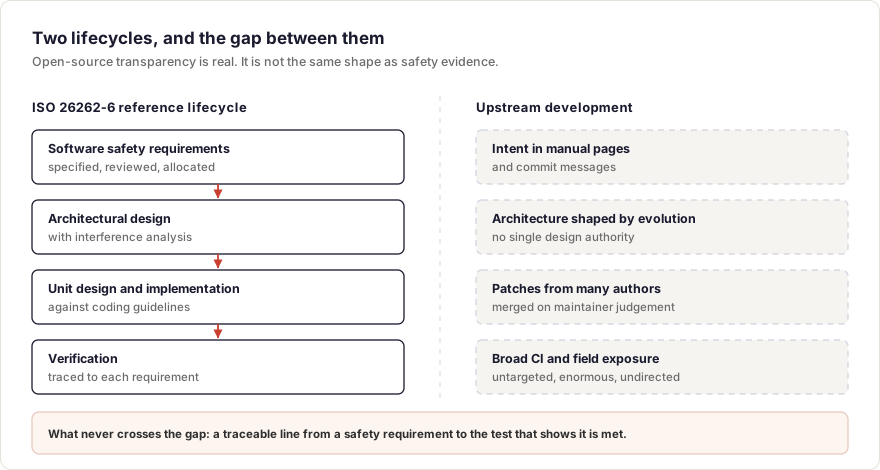
ISO 26262 Part 6 outlines a strict reference lifecycle. It expects safety requirements to flow down into architectural design, followed by implementation, and then verified through rigorous, traceable testing. Upstream open-source development operates on an entirely different paradigm. Instead of a signed safety requirements specification and a formal architectural design, a kernel offers informal intent in manual pages and commit messages, and an architecture shaped by continuous evolution.
Furthermore, open-source verification relies on massive, untargeted testing across continuous integration systems and broad field exposure. While this produces highly reliable software in general computing contexts, it lacks the traceability to safety requirements that ISO 26262 demands.
Pinning the Open-Source Element
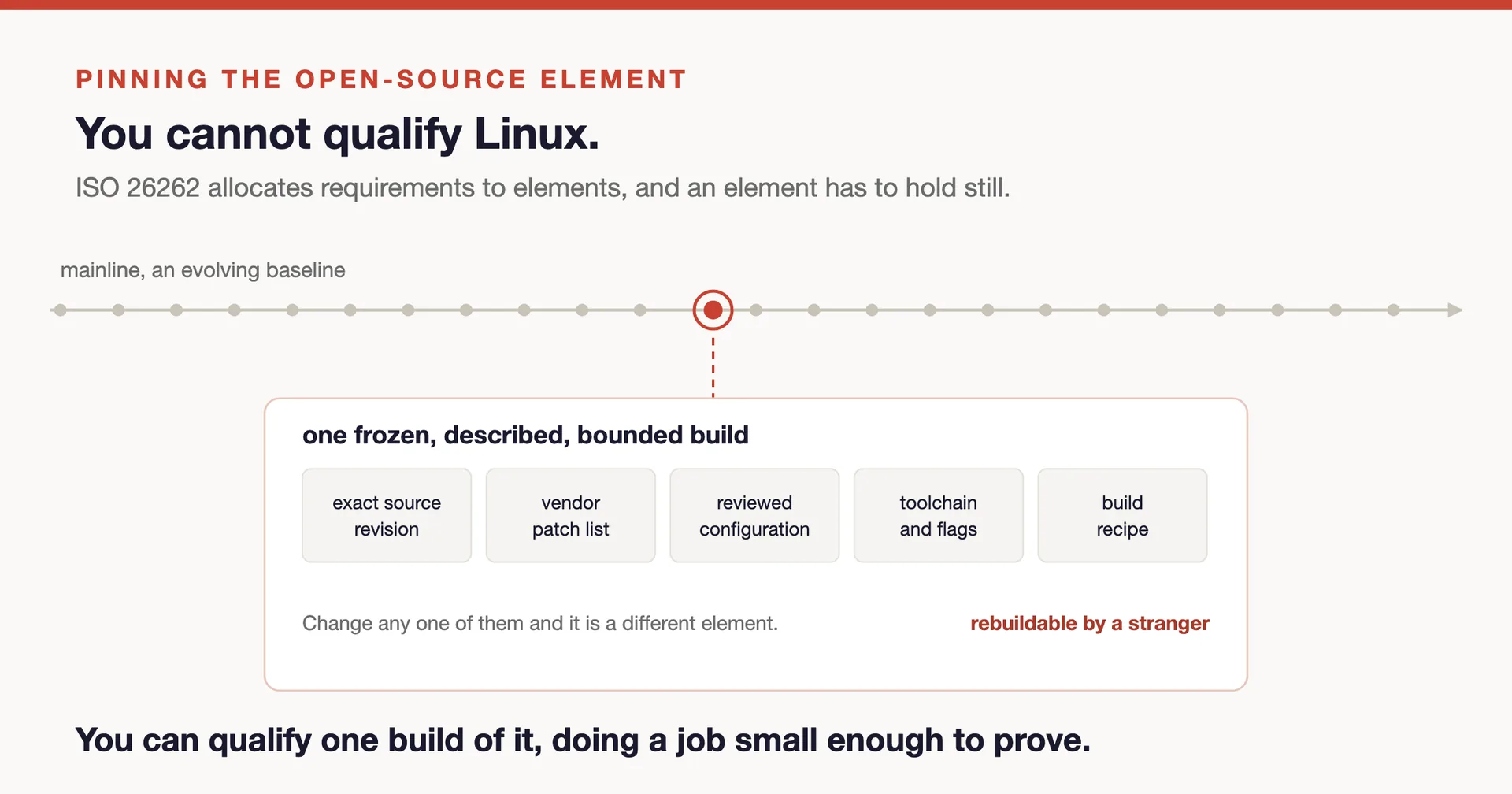
A common engineering error is attempting to qualify the operating system as a generic entity, and you cannot qualify a broad, shifting family of software. ISO 26262 requires reasoning about specific, versioned elements to which explicit safety requirements are allocated. The foundational step in open-source safety is defining an exactly specified software element.
Consider an Advanced Driver Assistance Systems (ADAS) domain controller running a customised Linux kernel that routes sensor data to the Automatic Emergency Braking (AEB) decision logic. The safety argument cannot rest on the general stability of a kernel version. It rests on the exact binary executing on that hardware.
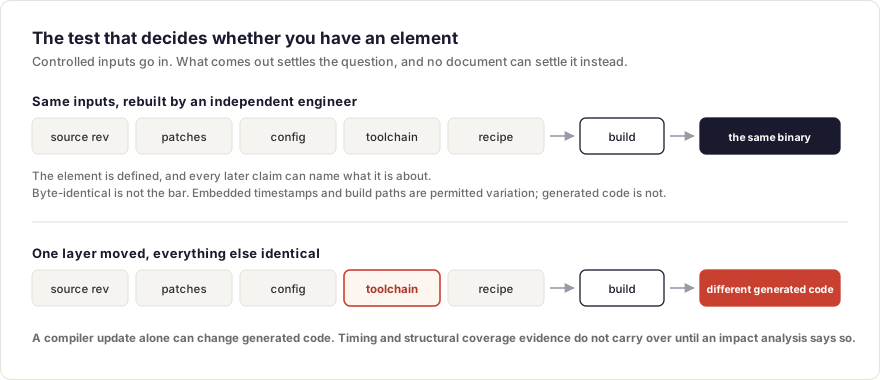
To achieve this, every layer of the software stack must be frozen and documented. This includes the exact source code revision, the applied vendor patches, the specific compiler version, and the build instructions. A change in the compiler alone can alter generated machine code, potentially invalidating timing analysis and structural coverage metrics. The test is blunt: hand your controlled inputs to an engineer who was not in the room, and see whether they arrive at the same binary or can account for every difference that remains. Embedded timestamps and build paths are permitted variation; generated code is not. Produce neither the binary nor that list, and the element stays undefined.
Constraining the Use Case
Defining the code is only half of the element definition; the other half is the constrained use case. Operating systems are built for unbounded functionality, arbitrary workloads and unpredictable environments, so claiming that a kernel is universally safe is an impossible task: no amount of evidence covers an unbounded state space.
The most effective lever in open-source qualification is narrowing the scope of the claim. Instead of validating the entire operating system, you validate a highly restricted subset of its capabilities. A workable claim specifies exactly which processes the kernel is allowed to schedule, which system calls those processes may invoke, and the strict timing bounds required for those operations.
| Claim Type | Scope Description | Engineering Reality |
|---|---|---|
| Impossible Claim | Unbounded functionality and arbitrary workloads across all environments. | Cannot be verified; state space is infinite and evidence generation is impossible. |
| Heroic Claim | Correctly provides full standard interfaces (e.g., POSIX) to arbitrary applications. | Technically possible to attempt seriously, but prohibitively expensive and time-consuming to finish. |
| Workable Claim | Schedules specific processes and serves a strict subset of system calls within timing bounds. | Highly bounded, testable, and capable of generating valid ISO 26262 assurance evidence. |
Documenting this constrained use case forces critical architectural decisions. The resulting specification dictates the boundaries of the software element, explicitly listing the allowed interfaces. Reducing the interface subset to a specific, countable list of system calls is what makes the verification effort possible to plan. It does not by itself bound the kernel: an allowed call still reaches the driver code behind it, while interrupts, direct memory access and kernel worker threads keep running underneath. The list is a scoping input, not a safety boundary.
Configuration as a Safety Artifact
The kernel build system contains thousands of configuration options that dictate which source files are compiled into the final binary. In a functional safety context, that file is not merely a build artifact; it is a scoping tool and a safety document.
Code that is excluded via configuration cannot execute in the deployed vehicle. Therefore, a safety-oriented configuration review is mandatory. This review must systematically disable every subsystem, device driver, file system, and network protocol that falls outside the constrained use case.
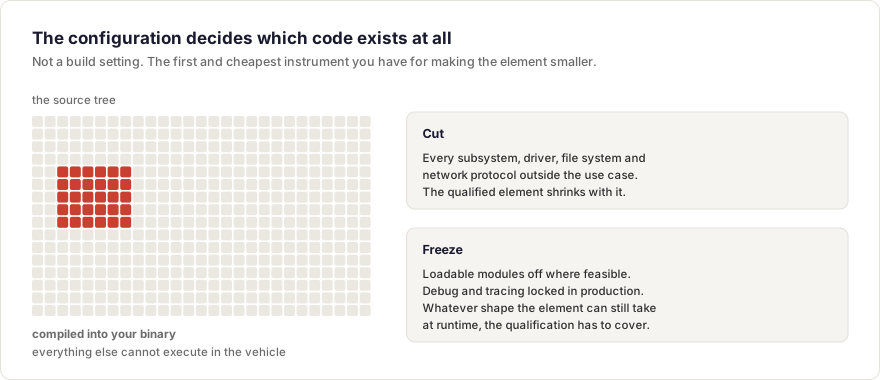
Beyond minimizing code, the configuration must freeze runtime mutability. Features like loadable kernel modules should be disabled to prevent the element from changing shape during operation. Debugging and tracing interfaces must be locked down in production builds. The final, reviewed configuration must include a written engineering rationale for every safety-relevant option, and any subsequent changes require a formal impact analysis.
Managing Assumptions of Use
The guidance in ISO 26262 Part 10 describes the Safety Element out of Context (SEooC): a component developed against assumed requirements, with the integrator responsible for verifying those assumptions within the final vehicle architecture. A kernel that already exists cannot be relabelled an SEooC after the fact, because SEooC is a way of developing something, not a badge. What transfers is the discipline of writing the assumptions down.
An operating system kernel cannot guarantee system-level safety on its own. It relies on specific hardware behaviours, memory protections and application-level fault handling. Whatever it cannot guarantee internally becomes an explicit assumption of use, which the integrating project must then confirm or compensate for.
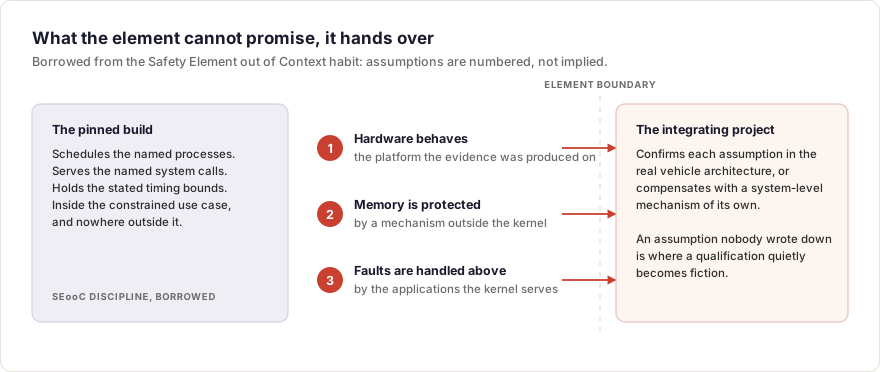
By borrowing that discipline for the pinned kernel build, the safety team establishes clear boundaries of responsibility. The resulting documentation bundle, containing the source revision, build recipe, constrained use case, and assumptions of use, forms the foundation for any subsequent qualification framework or gap analysis.
Conclusion
Applying ISO 26262 to Linux requires a shift in perspective: stop viewing the operating system as a dynamic ecosystem, and start treating it as a frozen, highly constrained engineering object. Pinning the source, restricting the use case, minimising the configuration and writing down the assumptions of use is what turns open-source code into an analyzable software element.
Which route then follows is a separate decision, and the usual candidates are qualification of the software component under Part 8 or a proven-in-use argument where the conditions for one genuinely hold. ISO/PAS 8926 sits earlier than that choice rather than beside it: it classifies a pre-existing software element and points at the safety activities that classification calls for, which is not the same as accepting the element. Neither route can be taken before the element exists. To go further, our Linux and Open-Source Safety concept page on the ISO 26262 Academy platform covers the route comparison, the gap analysis and the advanced qualification techniques in full.
Abbreviations & Key Definitions
- ADAS - Advanced Driver Assistance Systems, electronic systems that aid a vehicle driver while driving.
- AEB - Automatic Emergency Braking, a safety system that automatically applies brakes to prevent a collision.
- COTS - Commercial Off-The-Shelf, pre-existing software or hardware products available for purchase.
- ISO 26262 - The international standard for functional safety of electrical and/or electronic systems in production automobiles.
- POSIX - Portable Operating System Interface, the IEEE standards family for compatibility between operating systems.
- SEooC - Safety Element out of Context, a component developed with assumed safety requirements rather than specific item requirements.
Last updated: 16 October 2026


Comments
Loading comments