 ISO 26262Academy
Ask a team where their hazard analysis came from and they will point to a spreadsheet of hazardous events. Ask what the analysis assumed about the system, and the answer is often a meeting nobody wrote down. The document that should hold that answer is the item definition, the first work product of the ISO 26262 concept phase and the one with no predecessor.
ISO 26262-3:2018, Clause 5 is short, and that makes it easy to underestimate. Its job is to give the people doing the hazard analysis and the functional safety concept enough information to do their work. If the item definition is vague, those analyses fill the gaps with assumptions, usually different ones in different rooms.
A running example: a power sliding door
Take the electric sliding side door of a family van. It opens and closes at the push of a button, it latches itself, and it stops and reverses when it detects an obstacle. Simple enough. But as soon as you ask what can go wrong, you need facts that are not in the function description: how fast the door moves, how hard it pushes, when it is allowed to open, and which other systems tell it what the vehicle is doing.
Draw the boundary first
An item is a system, or a set of systems, that implements a function, or part of one, at vehicle level. The first real decision is what belongs inside it. For the door, the control unit, the drive motor, the latch and lock actuator, the anti-pinch sensing and the switches are clearly inside. The vehicle speed signal is not: it comes from the braking system, which is an item in its own right. Neither is the central lock command from the body controller.
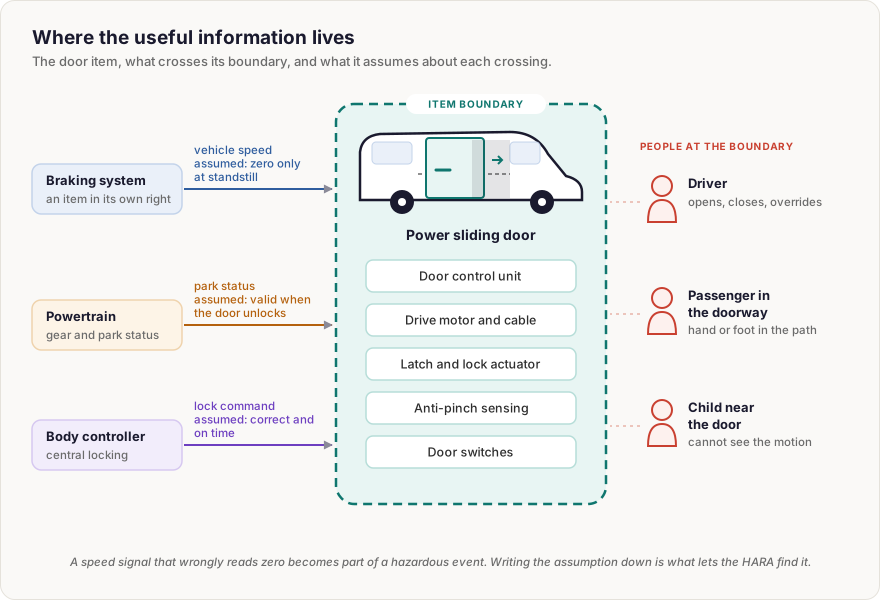
That boundary is where the useful information lives. The standard asks you to describe what the item needs from other items, what other items need from it, how functions are allocated across them, and what you assume about the interaction. For the door, the most important line on the diagram is the speed signal. If the door may only open when the vehicle is stationary, then a speed signal that wrongly reads zero becomes part of a hazardous event. Writing that dependency down is what lets the hazard analysis find it, and lets the functional safety concept later place a requirement on the braking system or add a plausibility check inside the door.
If your scope is a single component developed without a known vehicle, you are not defining an item at all. That is a safety element out of context, and it follows a different route, built on documented assumptions about its future use.
What the hazard analysis needs from you
The clause asks for the item's requirements and for its boundary, interfaces and assumptions. Two of those topics are where item definitions most often come up short.
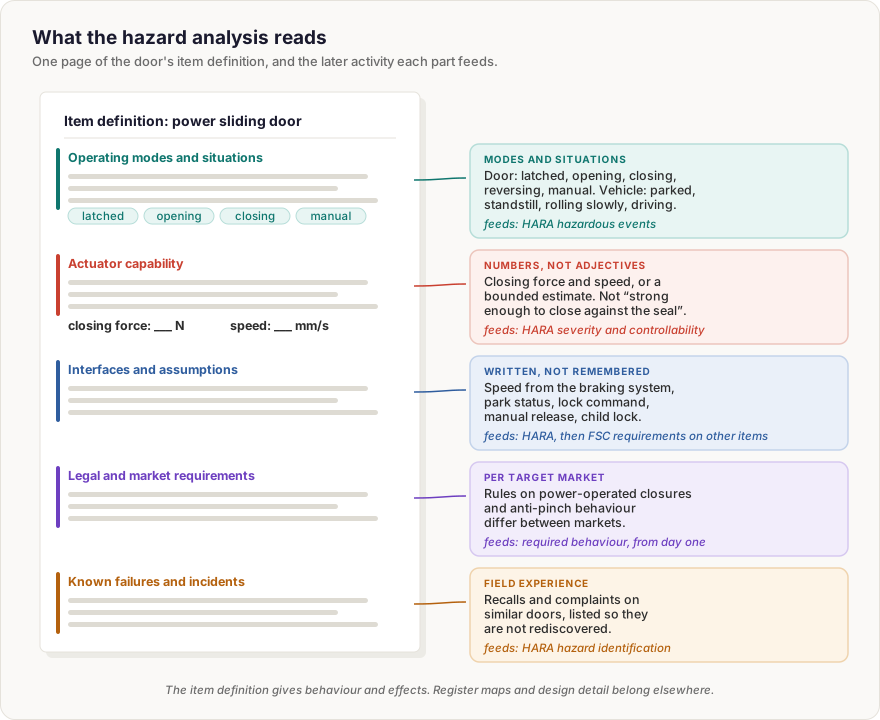
Operating modes and the situations they meet. The door has its own modes: latched, powered opening, powered closing, reversing after an obstacle, and manual operation after a power loss. The vehicle has its situations: parked, at a standstill with the engine running, rolling slowly, at highway speed. The hazard analysis combines the two. If the item definition only says "opens and closes on request", the analysis team invents both lists.
Actuator capability as numbers. Closing force and closing speed set the magnitude of what can happen to a hand or a child in the doorway. The standard asks for these values, or estimates, because severity and controllability depend on them. "Strong enough to close against the seal" is not a value.
The rest, from the legal requirements of each target market to the known failures of similar doors, follows the same logic: write down what the hazard analysis would otherwise have to guess.
Not a specification, and not frozen
An item definition describes behaviour and effects at vehicle level. It is not the system specification, and it does not stop changing when the hazard analysis starts. A door that gains a new feature late in development, or moves to a new van, needs its item definition revisited, and that decides how much of the concept phase has to be repeated.
The Item Definition concept page covers the full contents and how to write each part, operating modes and states, interfaces and assumptions in depth, new versus modified items, the route into the hazard analysis, the anti-patterns reviewers find, a review checklist and a complete worked example.
Abbreviations & Key Definitions
- HARA - Hazard Analysis and Risk Assessment.
- Item - A system or set of systems that implements a function at vehicle level.
- SEooC - Safety Element out of Context.
Last updated: 26 October 2026


Comments
Loading comments