
 ISO 26262Academy
Picture this: your resume lands on an HR manager's desk alongside 200 others for a coveted Functional Safety Manager position. Within seconds, their eyes scan for one critical credential that instantly separates contenders from candidates destined for the rejection pile. That credential? ISO 26262 certification. But with training costs ranging from $500 to $4,000 and over 20 providers claiming to offer the "gold standard," how do you maximize your return on investment?
The functional safety certification market has exploded alongside the automotive industry's shift toward electric vehicles and autonomous systems. Today, we'll dissect the true costs, hidden benefits, and strategic considerations behind choosing the right ISO 26262 certification path for your career trajectory.
The High-Stakes Certification Landscape
The numbers tell a compelling story about market demand. TÜV SÜD alone has certified over 500 engineers at the Professional level, while the broader market sees "extremely high" demand driven by ADAS and EV proliferation. Yet industry feedback reveals a paradox: while HR departments and OEMs heavily filter candidates based on these certifications, actual hands-on experience executing hazard analysis and risk assessment (HARA) or failure mode, effects, and diagnostic analysis (FMEDA) often proves more valuable for daily job performance.
This creates a strategic dilemma. Certification acts as the essential "HR filter bypass" that gets your resume past automated screening systems, but the real value lies in practical application. Understanding this dynamic is crucial for making informed investment decisions.
Consider the three certification levels available:
- Level 1: Engineer - Entry-level certification for new practitioners
- Level 2: Professional - Requires 3-6 years experience, targets safety managers
- Level 3: Expert - Demands 10+ years experience, aimed at assessors and auditors
The certification you choose should align with your career stage and target role within the functional safety ecosystem.
Cost-Benefit Analysis: Training vs. Exam-Only Paths
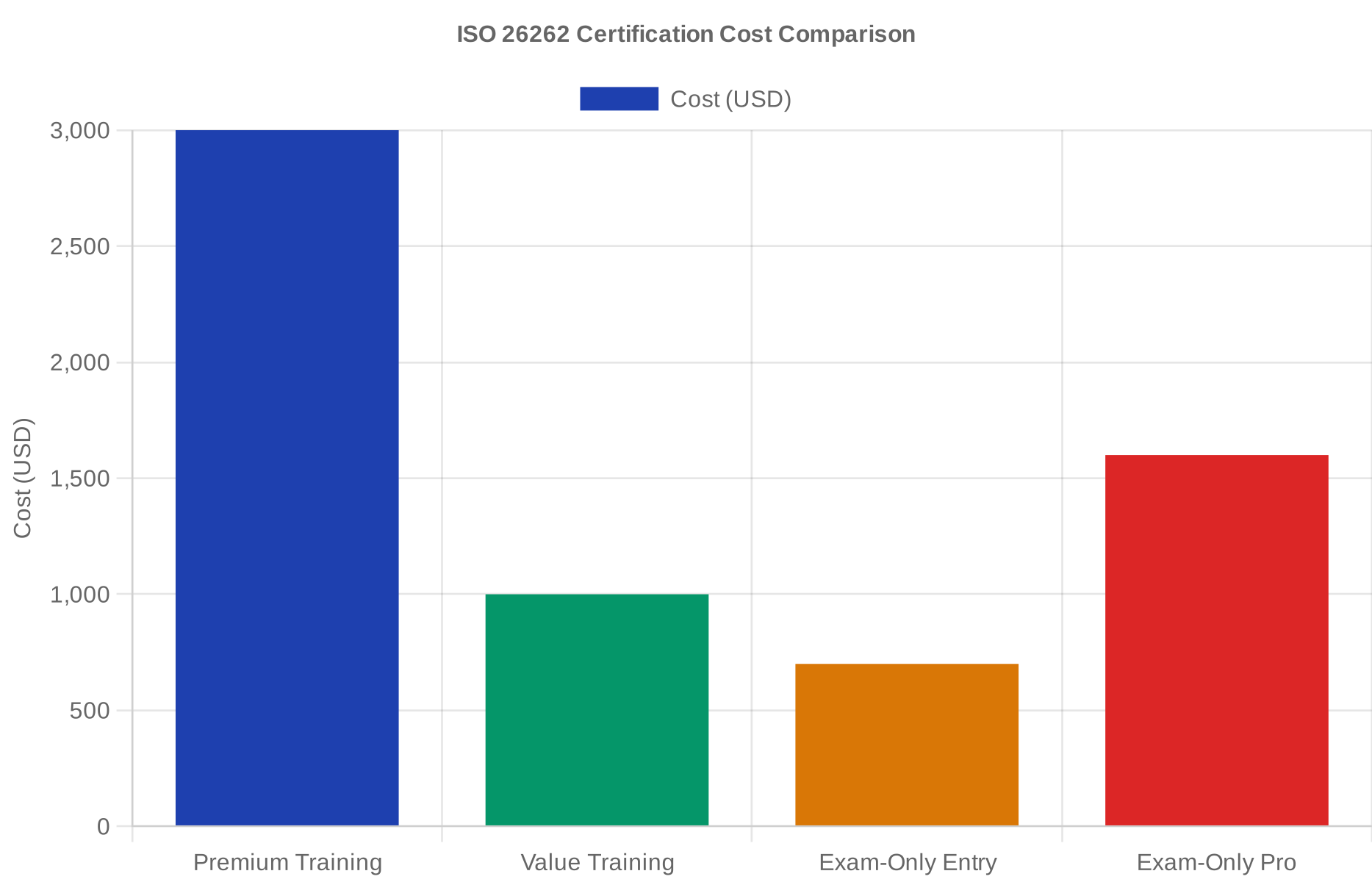 Cost comparison across certification tiers and approaches
The financial landscape of ISO 26262 certification varies dramatically based on your chosen approach. Our analysis of 20 leading providers reveals striking cost differences that directly impact ROI calculations.
The Premium Tier includes established names like TÜV SÜD, SGS-TÜV Saar, and TÜV Rheinland, with training plus exam packages ranging from $2,500 to $3,500. These providers offer comprehensive programs but command premium pricing for their brand recognition and rigorous examination standards.
The Value Tier features specialized providers like AutoFuSa and regional partners, offering competitive pricing between $500 to $1,500. These options provide excellent value for engineers in offshore development centers or those seeking cost-effective certification paths.
The Exam-Only Strategy represents the most cost-effective approach for experienced practitioners. Providers like Intertek allow direct exam applications without mandatory training, with Level 1 exams starting at €650 ($700) and professional levels reaching $1,600. This path requires confidence in your existing knowledge but can deliver exceptional ROI.
Industry feedback consistently recommends the exam-only route for budget-conscious professionals with practical experience, while emphasizing that intensive training becomes crucial for absolute beginners entering the functional safety domain.
Regional Market Dynamics and Strategic Considerations
| Provider | Region | Cost Range | Key Advantage | Best For |
|---|---|---|---|---|
| TÜV SÜD | Global | $3,000 | No expiration, gold standard | Career-long investment |
| SGS-TÜV Saar | Europe/US | $2,095 | Modular approach, small groups | Intensive learning |
| Intertek | Global | $700 - $1,350 | Exam-only option | Experienced professionals |
| AutoFuSa | India/Global | $500 - $1,000 | Competitive regional pricing | Budget-conscious engineers |
| Exida | Global | $2,000 - $3,000+ | Semiconductor expertise | Hardware safety engineers |
Top ISO 26262 certification providers comparison by region, cost, and key differentiators
Geographic factors significantly influence both certification costs and market recognition. European providers like TÜV SÜD and TÜV Rheinland maintain premium positioning due to their foundational role in establishing ISO 26262, with TÜV SÜD being a founding participant in the standard's development.
North American markets show strong preference for locally delivered programs, with providers like CS Canada and LHP Engineering Solutions bridging the gap between European standards and regional industry needs. These partnerships prove "vital for US/Canadian suppliers needing to prove compliance to European OEMs."
Emerging markets present unique opportunities, with providers like AutoFuSa offering globally recognized programs at significantly reduced costs. This creates arbitrage opportunities for international professionals willing to explore alternative certification paths.
The renewal factor adds another strategic dimension. While some certifications like TÜV SÜD offer unlimited validity, others require renewal every five years at approximately €390 ($420) plus proof of continued industry work. Factor these recurring costs into your long-term certification strategy.
Practical Application Focus: Beyond Theoretical Knowledge
The most successful certification programs emphasize hands-on application over theoretical memorization. Consider Omnex's approach: their five-day program uses an airbag system case study throughout, guiding participants through Item Definition, HARA execution, and Safety Concept development. This running case study approach "demystifies the theoretical standard" and bridges the gap between academic knowledge and practical implementation.
Similarly, Exida's partnership with Texas Instruments demonstrates industry-focused training. Their programs target semiconductor and embedded systems engineers, offering "the ultimate test of actual engineering knowledge rather than just standard memorization." This specialization proves invaluable for hardware-focused safety engineers.
For software-intensive applications, UL Solutions (Method Park) excels at integrating ASPICE and ISO 26262 requirements, making it "highly recommended for software teams and quality engineers looking to master process compliance."
The key insight: choose providers whose practical focus aligns with your intended application domain, whether that's system-level safety architecture, hardware reliability analysis, or software safety lifecycle management.
ROI Maximization Strategies
Smart certification investment requires strategic thinking beyond initial costs. Here's how to maximize your return:
Timing Strategy: Early registration discounts can reduce costs by 10-20%. Omnex and similar providers offer significant savings for advance booking, making timing a crucial factor in cost optimization.
Corporate vs. Individual Investment: Many providers offer corporate packages with better per-seat pricing. If your employer supports professional development, negotiate group rates or seek partial reimbursement for individual certification.
Complementary Certifications: Providers like SGS-TÜV Saar integrate related standards like ISO/SAE 21434 (cybersecurity) and SOTIF (intended functionality). This broader scope increases market value and addresses the convergence of safety, security, and AI reliability.
Long-term Career Planning: Consider certification validity periods and renewal requirements when evaluating total cost of ownership. Unlimited validity certificates may justify higher initial investment for long-term career planning.
The ultimate ROI comes from strategic career positioning. Functional Safety Manager roles represent a "highly compensated niche" with global demand exceeding qualified candidate supply. Your certification investment should align with this market reality.
Making the Strategic Choice
Your optimal certification path depends on three critical factors: current experience level, target market, and budget constraints. Entry-level engineers benefit from comprehensive training programs that build foundational knowledge, while experienced practitioners can leverage exam-only approaches for cost-effective credential acquisition.
Geographic considerations matter significantly. North American candidates often find better value in regionally focused providers, while international professionals may benefit from European premium brands for global recognition. The key lies in understanding your target employer's preferences and market positioning.
Remember that certification represents just the beginning of your functional safety journey. The real value emerges through practical application, continuous learning, and staying current with evolving automotive technologies like autonomous driving and electrification.
Ready to accelerate your functional safety expertise beyond basic certification? The ISO 26262 Academy offers comprehensive courses that bridge certification knowledge with practical implementation skills.
Start with our ASIL Classification Masterclass to deepen your risk assessment capabilities, or test your current knowledge with our free ISO 26262 practice exam to identify specific areas for improvement. Your next career breakthrough in functional safety starts with strategic learning choices today.
Abbreviations & Key Definitions
- ADAS - Advanced Driver-Assistance Systems, electronic systems that help drivers with safe driving tasks
- ASIL - Automotive Safety Integrity Level, a risk classification scheme defined by ISO 26262
- ASPICE - Automotive SPICE, a framework for software development processes in the automotive industry
- EV - Electric Vehicle, vehicles powered by electric motors using energy stored in batteries
- FMEDA - Failure Mode, Effects, and Diagnostic Analysis, a systematic method for analyzing potential failures
- HARA - Hazard Analysis and Risk Assessment, the process of identifying hazards and evaluating associated risks
- HR - Human Resources, the department responsible for recruiting and managing employees
- ISO 26262 - International standard for functional safety of electrical/electronic systems in production automobiles
- OEM - Original Equipment Manufacturer, companies that produce vehicles or systems for automotive use
- ROI - Return on Investment, a measure of the efficiency of an investment
- SOTIF - Safety of the Intended Functionality, standard addressing safety risks from intended behavior
Last updated: 2 October 2026

Comments
Loading comments